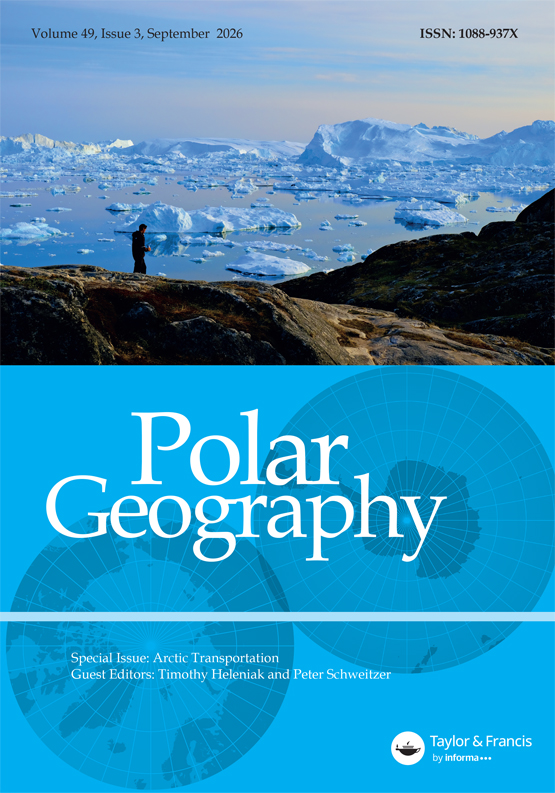
Nov 2026: InfraNorth Special Issue in Polar Geography
“Arctic Transportation” is the latest special issue of the quarterly peer-reviewed journal Polar Geography (Volume 49, Issue 3, November 2026), guest-edited by InfraNorth senior researcher Timothy Heleniak and principal investigator Peter Schweitzer.
Transport infrastructure and population in the Arctic
The introduction to the special issue provides a conceptual framework and presenting the four contributions here collected, all of which engage with the core question of the InfraNorth project: What role do transport infrastructures play in sustaining northern communities?
The special issue examines roads, railways, airports and seaports, and their importance in enabling the movement of people, goods and resources into, across and out of the Arctic. While such infrastructures are typically planned and built by outside actors and interests, the project centers on permanent Arctic residents, both Indigenous and non-Indigenous, whose livelihoods can be profoundly affected by transport infrastructure in direct and indirect ways. The issue brings together four articles addressing these local impacts and the relationships between transport infrastructure and Arctic communities.
Temporality of infrastructure
In “Temporality of Arctic Transport Infrastructure: Bridging Seasonal Supply in Egvekinot, Chukotka,” InfraNorth researchers Elena Davydova and Olga Povoroznyuk examine the local impacts of (and responses to) seasonal configurations of connectivity and disruptions in the functioning of transport infrastructure in the Russian Arctic. Drawing on qualitative ethnographic research in Egvekinot, Chukotka, they analyse how transport infrastructures, subject to ongoing social and environmental changes, are perceived and used as highly seasonal and constantly evolving structures. While considering historical processes and modernization ideologies, they pay particular attention to cyclical, repetitive and fleeting seasonal time and its role in shaping infrastructure, communities and social relations.
Their case study shows how local residents and actors manage seasonal interruptions in chains of supply through future-oriented dwelling activities. Davydova and Povoroznyuk argue that different seasonal configurations of transport infrastructure serve to fill the gaps in supply chains and to ensure local mobility and provisioning throughout most of the year.
Housing scarcity and infrastructural relations
In “No room in the North: housing scarcity as infrastructure’s failed relations in the Arctic,” InfraNorth researchers Katrin Schmid and Ria-Maria Adams examine the entanglements of housing infrastructure, economic structures and social relations in two Arctic communities: Nunavut, Canada, and Malmfälten, Sweden. Using a comparative ethnographic approach, the authors explore how housing scarcity is shaped not only by physical infrastructure but by broader political and economic forces.
Rather than viewing infrastructure as a static entity, they adopt a relational perspective that emphasizes the reciprocal dynamics between housing, social networks, and state policies. Their findings suggest that housing scarcity in the Arctic is not merely a consequence of remoteness or material limitations but a product of structural neglect, economic disincentives, and governance complexities.
By framing infrastructure as a site of contested relations rather than a neutral technical system, the authors argue that addressing Arctic housing challenges requires not only increased investment but a fundamental rethinking of infrastructural governance, social responsibility, and sustainability in northern communities.
Infrastructure, visions of the future and the politics of belonging
In “2200 meters: infrastructure, the future, and the politics of belonging in Greenland and the Arctic,” InfraNorth associate researcher Susan Vanek examines Greenland’s airport expansion project, approved by the Government of Greenland in 2015 as the largest investment in transportation infrastructure ever undertaken by the island’s autonomous government. Involving the expansion of two existing airports and the construction of a new regional hub, the project promises greater global connectivity but also entails a realignment of the island’s transport network, increasing access for some communities while contributing to the isolation and displacement of others.
Focusing on the experience of the airport expansion project in two communities, Vanek interrogates how legacies of the past and visions of the future intermix and coalesce around large-scale infrastructural projects, an what they can reveal about the interconnection between state policy, the politics of belonging, and the future of Arctic communities.
Hyperconnected remoteness and community transitions
In “Hyperconnected remoteness: the Svalbard airport and community transitions in Longyearbyen,” InfraNorth researcher Alexandra Meyer examines the role of Svalbard Airport in shaping socio-economic transitions and everyday life in Longyearbyen, the largest settlement on the Svalbard archipelago. She draws on long-term ethnographic fieldwork and historical sources to trace how the airport has mediated experiences of remoteness and connectivity across successive historical periods: from Longyearbyen’s origins as an isolated coal-mining company town to its current post-industrial economy based on tourism, research and education. She demonstrates how the airport has functioned both as a product and driver of state-led normalization, economic diversification and geopolitical presence.
The article argues that increased connectivity does not eliminate remoteness but gives rise to ‘hyperconnected remoteness,’ a condition in which extreme accessibility and isolation coexist. By focusing on an Arctic island context, the article contributes new insights into the transformative power of transport infrastructure and the ambivalent social effects of connectivity in remote settings.