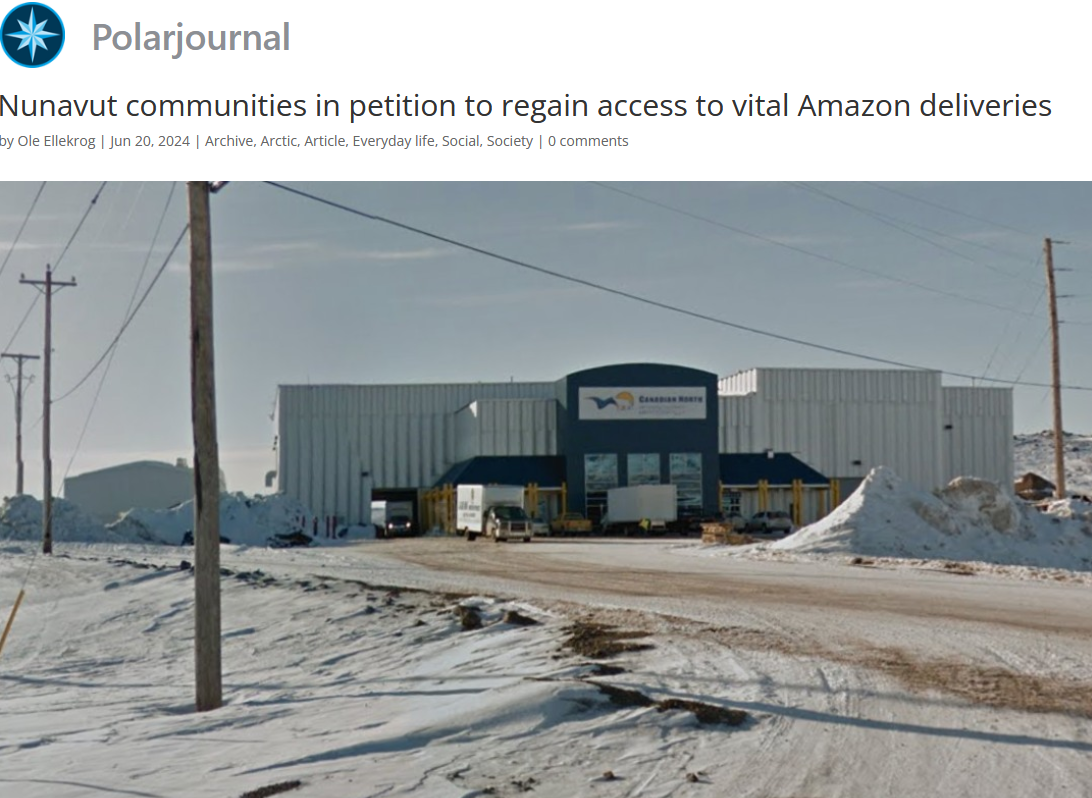
Drawing on conversations that the InfraNorth researcher had with residents of Nunavut during her fieldwork, the article highlights the crucial role that the trillion-dollar corporation Amazon.com, Inc. has played for local communities since opening a warehouse in Iqaluit in 2020. The new Amazon hub allowed people living in remote areas of northern Canada to access previously unaffordable goods without shipping costs. This was especially important in a region where transportation logistics, storage capacities, and food insecurity are critical issues. However, the company discontinued access to free deliveries in the spring of 2024. The article follows a recent petition campaign to extend Amazon Prime services to the region.
Food and Foodways, a refereed, interdisciplinary and international journal devoted to the history and culture of human nourishment, has recently published the article “Between food and refuse: Enacting (in)edibility in the Russian Arctic” by InfraNorth researcher Elena Davydova. In this article, Davydova interrogates the contingent boundaries between food and waste in the Russian Arctic, analyzing […]
The book chapter “Remote connections: Human entanglements with built and natural environments in the Arctic and elsewhere,” written by InfraNorth principal investigator Peter Schweitzer and published as part of Anthropology in Motion, edited by Andre Gingrich and published by Sean Kingston Publishing in 2021, is now available open access. In the chapter, Schweitzer revisits the […]
We invite paper proposals for our panel “High Altitudes, High Latitudes: Engaging with Cryospheric Livelihoods” at the Vienna Anthropology Days (VANDA) 2027, hosted by the Department of Social and Cultural Anthropology at the University of Vienna, 16-19 February 2027. The cryosphere, defined by frozen water in all its forms, has attracted considerable attention of late […]
We invite paper proposals for our panel “Infrastructuring Green Transitions” at the Vienna Anthropology Days (VANDA) 2027, hosted by the Department of Social and Cultural Anthropology at the University of Vienna, 16-19 February 2027. The green transition marks a shift away from fossil fuel-based, high-carbon economic activity toward more sustainable systems of production, consumption, and […]
We invite paper proposals for our panel “Whose Arctic Futures? Unsettling Northern Transport Infrastructures” at the Vienna Anthropology Days (VANDA) 2027, hosted by the Department of Social and Cultural Anthropology at the University of Vienna, 16-19 February 2027. The Arctic, which during the post-Cold War period at the turn of the last century seemed to […]
We invite paper proposals for our panel “Infrastructures: Questions, Debates, and Directions” at the Vienna Anthropology Days (VANDA) 2027, hosted by the Department of Social and Cultural Anthropology at the University of Vienna, 16-19 February 2027. The panel explores infrastructure as both an object of anthropological inquiry and an analytical lens. It welcomes empirical, conceptual, […]