Jan 9, 2025: Presentation by Olga Povoroznyuk and Peter Schweitzer at the RATIC Arctic Infrastructure Science Talks Series
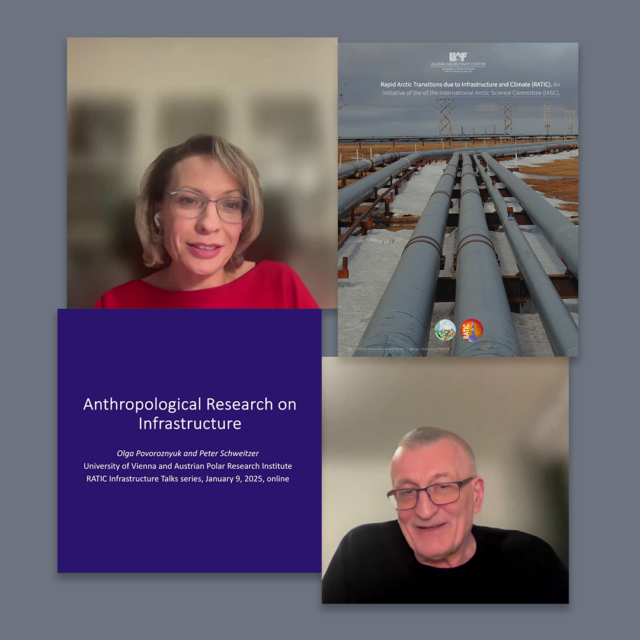
Peter Schweitzer and Olga Povoroznyuk were guest speakers at the 2024-2025 RATIC
“Arctic Infrastructure Science Talks”.

Peter Schweitzer and Olga Povoroznyuk were recently invited as guest speakers of the RATIC Arctic Infrastructure Science Talks, a short series of online talks hosted by Jana Peirce (Alaska Geobotany Center, University of Alaska Fairbanks) in preparation for the Arctic Science Summit Week 2025 and the ICARP IV Summit. Each talk is followed by time for discussion that focuses on research priorities for the next 10 years. Their talk aimed to provide an overview of recent developments in anthropological research on infrastructure, keeping a regional focus on the Arctic and providing empirical examples from their past and ongoing research projects.

Povoroznyuk and Schweitzer noted that “it has been only recently that the social sciences and humanities have engaged with infrastructure in earnest,” and that “anthropology was a latecomer to infrastructure studies, but more recently there has been a veritable explosion of anthropological literature on the subject.” For them, a main thrust of anthropological research has been conducted to show how infrastructures become terrains for political engagement. Thus, social anthropology explores infrastructure as political and modernization projects and social agents: “It focuses on infrastructure imaginaries, promises, and processes of (mal)functioning, ruination, and reconstruction to investigate cultural dynamics and social conflicts and movements,” they said.

According to both InfraNorth researchers, social scientists and anthropologists focusing on Arctic infrastructure have been studying entanglements between local and Indigenous communities and infrastructure in the contexts of rapid climate change, remoteness, and resource extraction. “While there is a long history of social impact assessments of development projects, anthropologists and other social scientists working in the Arctic, should focus more on social configurations of privileges and inequalities resulting from the affordances and “fly-over” effects of infrastructure, as well as on different forms of knowledge produced by infrastructure,” they argued.

The international multidisciplinary research network, Rapid Arctic Transitions due to Infrastructure and Climate (RATIC), is an initiative of the International Arctic Science Committee (IASC).


Sep 2026: Chapter by Peter Schweitzer in “Anthropology in Motion” (Andre Gingrich, Ed.) Now Open Access

The book chapter “Remote connections: Human entanglements with built and natural environments in the Arctic and elsewhere,” written by InfraNorth principal investigator Peter Schweitzer and published as part of Anthropology in Motion, edited by Andre Gingrich and published by Sean Kingston Publishing in 2021, is now available open access. In the chapter, Schweitzer revisits the […]

Vienna Anthropology Days - VANDA 2027 Call for Papers

Call for Papers on “High Altitudes, High Latitudes: Engaging with Cryospheric Livelihoods” for VANDA Conference 2027

We invite paper proposals for our panel “High Altitudes, High Latitudes: Engaging with Cryospheric Livelihoods” at the Vienna Anthropology Days (VANDA) 2027, hosted by the Department of Social and Cultural Anthropology at the University of Vienna, 16-19 February 2027. The cryosphere, defined by frozen water in all its forms, has attracted considerable attention of late […]

Vienna Anthropology Days - VANDA 2027 Call for Papers

Call for Papers on “Infrastructuring Green Transitions” for VANDA Conference 2027

We invite paper proposals for our panel “Infrastructuring Green Transitions” at the Vienna Anthropology Days (VANDA) 2027, hosted by the Department of Social and Cultural Anthropology at the University of Vienna, 16-19 February 2027. The green transition marks a shift away from fossil fuel-based, high-carbon economic activity toward more sustainable systems of production, consumption, and […]

Vienna Anthropology Days - VANDA 2027 Call for Papers

Call for Papers on “Whose Arctic Futures? Unsettling Northern Transport Infrastructures” for VANDA Conference 2027

We invite paper proposals for our panel “Whose Arctic Futures? Unsettling Northern Transport Infrastructures” at the Vienna Anthropology Days (VANDA) 2027, hosted by the Department of Social and Cultural Anthropology at the University of Vienna, 16-19 February 2027. The Arctic, which during the post-Cold War period at the turn of the last century seemed to […]

Vienna Anthropology Days - VANDA 2027 Call for Papers

Call for Papers on “Infrastructures: Questions, Debates, and Directions” for VANDA 2027

We invite paper proposals for our panel “Infrastructures: Questions, Debates, and Directions” at the Vienna Anthropology Days (VANDA) 2027, hosted by the Department of Social and Cultural Anthropology at the University of Vienna, 16-19 February 2027. The panel explores infrastructure as both an object of anthropological inquiry and an analytical lens. It welcomes empirical, conceptual, […]

Cover of the Polar Geography journal.

Aug 2026: Introduction to InfraNorth Special Issue in Polar Geography

The quarterly peer-reviewed journal Polar Geography has published the introduction to the forthcoming special issue “Transport infrastructure and population in the Arctic.” The introduction has been written by InfraNorth senior researcher Timothy Heleniak and principal investigator Peter Schweitzer. Published online in August 2026, the introduction presents the special issue emerging from the InfraNorth project. At […]