Jan 9, 2025: Presentation by Olga Povoroznyuk and Peter Schweitzer at the RATIC Arctic Infrastructure Science Talks Series
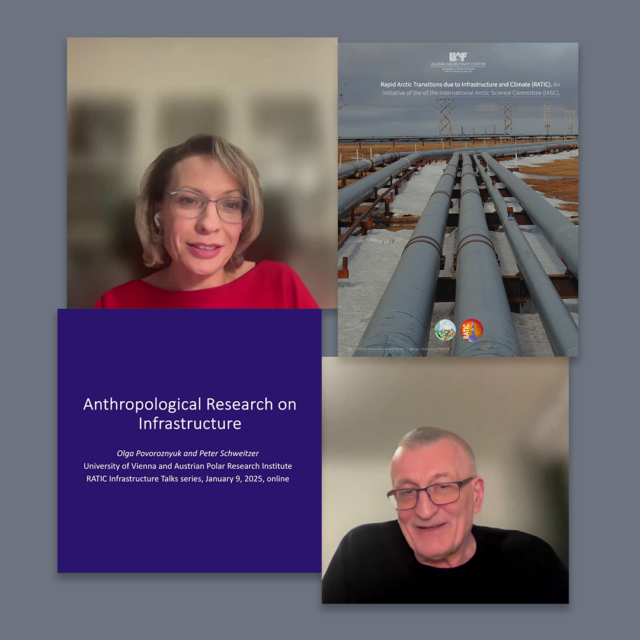
“Arctic Infrastructure Science Talks”.
Peter Schweitzer and Olga Povoroznyuk were recently invited as guest speakers of the RATIC Arctic Infrastructure Science Talks, a short series of online talks hosted by Jana Peirce (Alaska Geobotany Center, University of Alaska Fairbanks) in preparation for the Arctic Science Summit Week 2025 and the ICARP IV Summit. Each talk is followed by time for discussion that focuses on research priorities for the next 10 years. Their talk aimed to provide an overview of recent developments in anthropological research on infrastructure, keeping a regional focus on the Arctic and providing empirical examples from their past and ongoing research projects.
Povoroznyuk and Schweitzer noted that “it has been only recently that the social sciences and humanities have engaged with infrastructure in earnest,” and that “anthropology was a latecomer to infrastructure studies, but more recently there has been a veritable explosion of anthropological literature on the subject.” For them, a main thrust of anthropological research has been conducted to show how infrastructures become terrains for political engagement. Thus, social anthropology explores infrastructure as political and modernization projects and social agents: “It focuses on infrastructure imaginaries, promises, and processes of (mal)functioning, ruination, and reconstruction to investigate cultural dynamics and social conflicts and movements,” they said.
According to both InfraNorth researchers, social scientists and anthropologists focusing on Arctic infrastructure have been studying entanglements between local and Indigenous communities and infrastructure in the contexts of rapid climate change, remoteness, and resource extraction. “While there is a long history of social impact assessments of development projects, anthropologists and other social scientists working in the Arctic, should focus more on social configurations of privileges and inequalities resulting from the affordances and “fly-over” effects of infrastructure, as well as on different forms of knowledge produced by infrastructure,” they argued.
The international multidisciplinary research network, Rapid Arctic Transitions due to Infrastructure and Climate (RATIC), is an initiative of the International Arctic Science Committee (IASC).