Mar 14, 2026: Presentation by Elena Davydova at the Ludwig Maximilian University of Munich
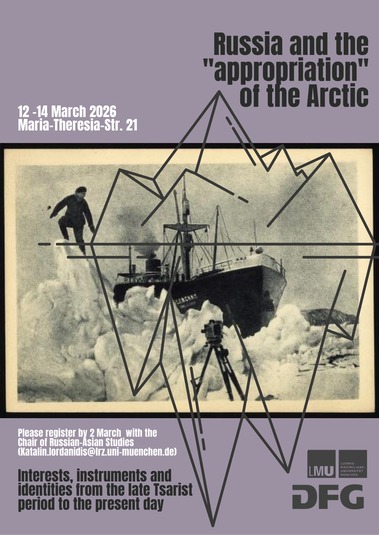
InfraNorth researcher Elena Davydova will be presenting at the international conference Russia and the “appropriation” of the Arctic organized by the Chair of Russian-Asian Studies at the Ludwig Maximilian University of Munich. With the subtitle “Interests, instruments and identities from the late Tsarist period to the present day,” the conference will take place from March 12 to 14, 2026, at Maria-Theresia-Str. 21. Her presentation, “From Osvoenie to Dwelling: Local Re-Appropriations of Arctic External-Driven Infrastructures through Small-Scale Food Production,” will take place as part of Session 7, titled “Urbanisation as appropriation,” on Saturday, March 14, at 11:40 CET.
In her presentation, the InfraNorth researcher will delve into the (Post-)Soviet “appropriation” (osvoenie) of the Russian North, which implies the implementation of multiple infrastructural projects that boosted the colonisation processes, including extractive activities, scientific research, mobilities, relocations of people, sovietisation of local populations, and militarisation of the region. There is an extensive scholarship focusing on the industrial, material, and infrastructural manifestations of the appropriation or mastering of the North from the perspective of top-down processes (Slezkine 1994, Bruno 2016). Her research pays attention to local re-appropriation of externally-driven infrastructure objects. It asks how residents of Arctic settlements re-own state-built infrastructures through dwelling practices such as gardening and small animal keeping. Furthermore, in what ways do these practices transform the intended functions and meanings of infrastructure? At last, how do these forms of re-appropriation relate to official narratives of osvoenie?
Davydova’s research draws on long-term ethnographic fieldwork conducted in both settler and Indigenous communities of the Iul’tinskii district in Chukotka, complemented by archival investigation. These settlements served as key outposts during the Soviet exploration of northwestern Chukotka. Early Soviet geological expeditions identified several mineral deposits in the region, which became a driving force behind large-scale infrastructural development and, consequently, a central mechanism of Soviet appropriation. Following the dissolution of the USSR, mines were shut down, entire settlements were abandoned, and infrastructures were either left to deteriorate or selectively maintained. High unemployment, inflation, and disruptions in supply chains triggered a drastic population decline. Food insecurity, culminating at times in near-collapse of provisioning systems, was one of the most immediate and visible manifestations of the crisis for local residents (Gray 2021).
Yet from the perspective of human life, infrastructures possess a material longevity that far exceeds the institutions that created them; they persist on a different temporal scale (Appel et al. 2018: 20). The slow ruination or material endurance of Soviet-built infrastructures embeds these objects in the fabric of contemporary everyday life, even when they have been abandoned by the state or private stakeholders. Davydova’s contribution examines how urban, energy, and transport infrastructures become entangled in local food production, particularly household subsistence activities. These practices of small-scale food production serve as the analytic lens for tracing local re-appropriations of (post)Soviet infrastructural objects.
The InfraNorth researcher argues that food-related dwelling practices (Ingold 2000) actively domesticate inherited infrastructures, integrating them into local landscapes and everyday rhythms. Through gardening, animal keeping, and other subsistence activities, residents transform these built structures, often imagined by planners as instruments of extraction and control, into components of a lived environment in which natural and built elements merge. These practices make infrastructure habitable: they enable people to exert a sense of control over their surroundings and, by extension, over the conditions of their own lives. In doing so, local actors reconfigure the intended purposes of infrastructure, producing a persistent mismatch between official designs and actual uses. Yet this misalignment is not merely an unintended consequence. It illustrates the creative agency of dwellers, who repurpose infrastructural remains to sustain households, remake place, and negotiate the legacies of osvoenie on their own terms.
Davydova’s presentation will contribute to the conference’s discussion of Arctic appropriation by foregrounding osvoenie as a multifaceted process, rather than a solely top-down project of conquest or modernization. It will demonstrate how infrastructures initially designed as instruments of state-led appropriation acquire new roles as resources for local autonomy and survival. She will highlight practices of place-making that both hybridize and subtly unsettle Soviet and Russian visions of Arctic modernity. These quiet, everyday re-appropriations bring into view the lived experiences, agency, and perspectives of local residents, thereby adding an essential bottom-up dimension to the broader history of osvoenie.
Find out more about the conference on the website of the LMU Chair of Russian-Asian Studies.