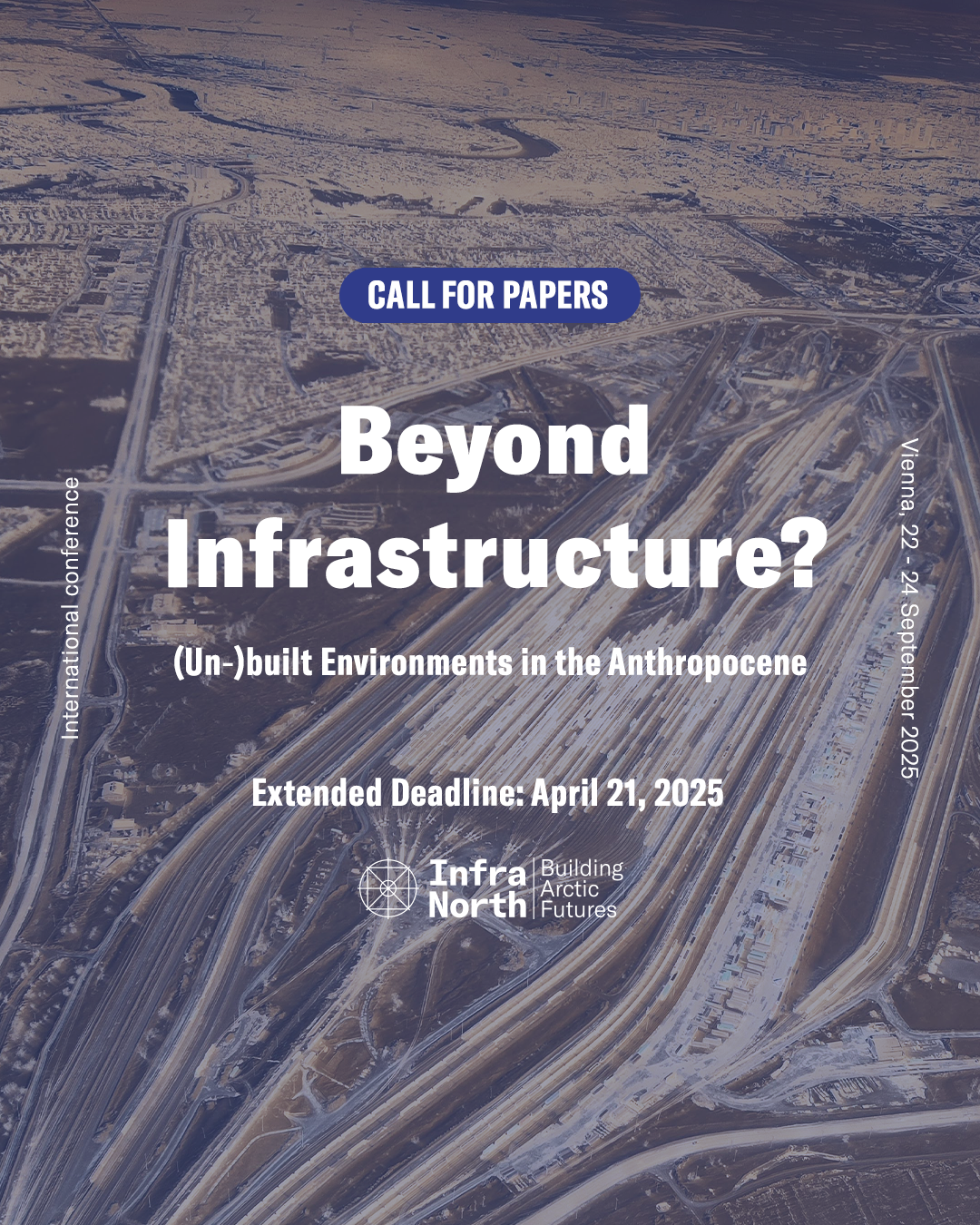
Call for Papers “Beyond Infrastructure? (Un-)built Environments in the Anthropocene”
International Conference, September 22 – 24, 2025, at the University of Vienna. Extended deadline for submissions: April 21, 2025.
Infrastructure is often seen as solid, fixed, and inevitable while shaping the way we move, live, and connect. But what about the infrastructures that remain unfinished, abandoned, or merely imagined? How do built, un-built, or non-built environments shape politics, everyday life, and ecological futures? And what happens when we move past conventional understandings of infrastructure?
The Department of Social and Cultural Anthropology at the University of Vienna, together with the ERC project “Building Arctic Futures: Transport Infrastructures and Sustainable Northern Communities (InfraNorth)” as a scientific cooperation partner, invite you to participate in the International Conference “Beyond Infrastructure? (Un-)built Environments in the Anthropocene” from September 22 to September 24, 2025, at the University of Vienna.
Engaging with a variety of issues stemming from human and more-than-human interactions with built, unbuilt, and not-yet-built environments, this conference infuses infrastructure studies with environmental perspectives. While hosted by anthropologists, we see ourselves as part of an interdisciplinary field, which includes other social sciences, the arts and humanities, as well as the natural sciences and engineering. Though InfraNorth is focused on the Arctic, we welcome contributions dealing with any part of the globe (and beyond).
The conference will start on Monday evening (September 22) with a keynote presentation by Alessandro Rippa (University of Oslo), titled “Anthropocene Landscapes? Or, a Renewed Anthropology of Infrastructure for the Current Times.” Over the next two days (September 23–24), we will continue this conversation through participant presentations, organized into thematic sessions that encourage stimulating connections and debates.
To submit your paper proposal, please provide the following:
1) An abstract of up to 250 words,
2) Five keywords characterizing your research,
3) A short bio of 50-70 words.
Please send everything as one PDF document no later than April 21 to beyondinfrastructure.ksa@univie.ac.at. We intend to communicate our decisions regarding acceptance in early May. Registration will start thereafter.
The registration fees are indicated in the table below and will cover coffee breaks on September 23 and 24, as well as a reception after the keynote on September 22. Audience online participation will be possible but paper presentations will be limited to in-person attendees.
| Early-bird registration until July 6, 2025 | Later registration from July 7, 2025 | |
|---|---|---|
| Regular | 90 € | 135 € |
| Early career scholars (PhD candidates, PhD + 5 years) | 60 € | 90 € |
| Students (BA & MA) | 45 € | 70 € |
| Online participants | 20 € | 30 € |
More details will be announced soon on this website and you can follow us on Bluesky, Instagram, and Facebook for updates.